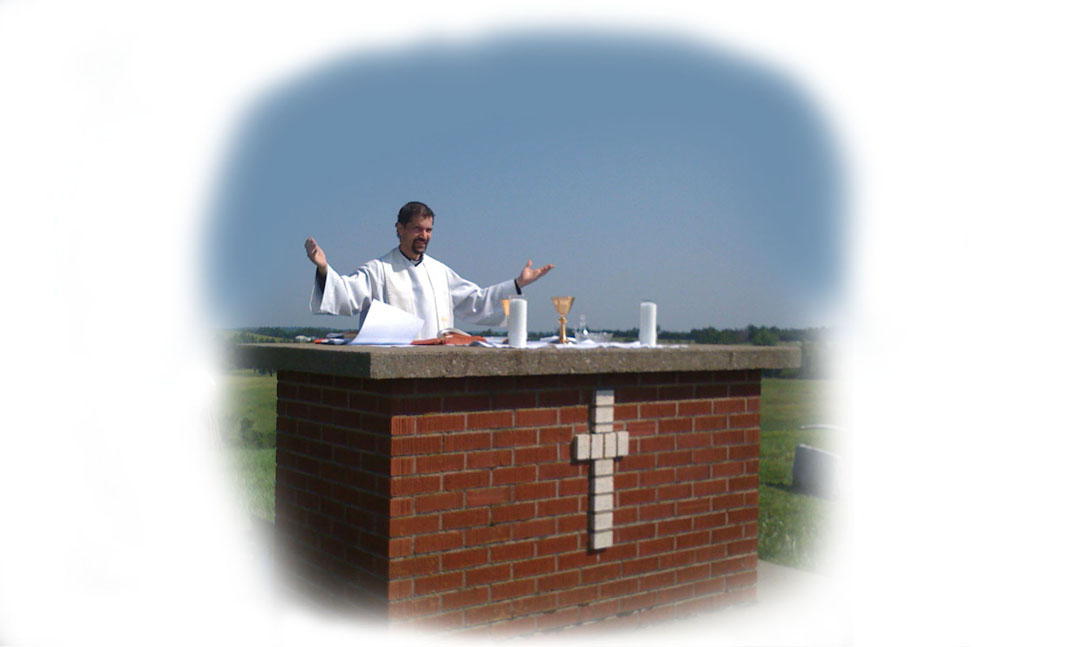
Catholic Mass?
On Memorial Day, May 30th, 2011, I attended Catholic Mass, in a graveyard, high on a hill in a rural region of Kentucky's farmland. In addition to honoring the men and women who have died protecting our American way of life, for me, the experience served as a priceless reminder of just what the Catholic Mass represents.
Like many of my Catholic cohorts, I have heard criticisms of the ritualistic nature of the Mass. Yes, it is ritualistic. We sing hymns, chant prayers, sit, stand, kneel, and do readings from the Holy Bible, all pretty much in the same format day after day, week after week, year after year. It is understandable that outsiders would find it odd. Yet, true Catholics realize there is a real biblical purpose to the format of the Catholic Mass.
If one enters a Catholic Church, Cathedral, or even Father Brian Johnson's Memorial Day Mass high on that hill in Grayson County, KY, they should observe the physical characteristics of what is happening. As in the Old Testament, a congregation of followers are gathered. In front there will be a high place (in all Catholic churches the altar area is raised). On that high place will be a sacrificial altar. On that altar, a priest will perform a sin sacrifice. Throughout history, mankind has performed sin sacrifices. However, in the Catholic Church, it is done as prescribed by Jesus Christ in the Bible.
To understand the Catholic sin sacrifice, one must look back into the Old Testament. There was a time in history when men were making all sorts of sacrifices to the gods for all kinds of reasons. On occasions, even children were sacrificed on high places by individuals or communities because they believed that natural disasters were being caused by angered gods. Scripture describes a time when a king actually sacrificed his own son, heir to the thrown, in hopes of gaining a divine advantage in battle. Imagine the cruelty of sacrificing innocent children for something they had absolutely nothing to do with.
The story of Abraham and his son Isaac, is an indication of how bad it had become. It would seem that in a dream, God told Abraham to take his innocent son up on a mountain (high place), place him on a rock (altar), and sacrifice him. Abraham awoke and proceeded to do as told. He took young Isaac to the mountain, tied him to the makeshift altar, and was about to kill him when the Angel of the Lord stopped him. The angel then told Abraham to remove his son from the altar, and to replace the boy with a sheep that was caught up in the nearby thicket. Most Christians describe this passage as God's way of testing Abraham's obedience. I choose to believe the story had a larger meaning. Abraham, though obedient, would not have attempted such a tragic feat were it not common practice in that period of history. I suggest the angel was telling Abraham to go back and tell his people that God does not want them sacrificing their children. Instead they should use an animal. The killing of animals for sin sacrifice continued for thousands of years.
Before his death, Jesus Christ described himself as The Lamb of God. He was to be the last living sacrifice. On the night before his death, Christ broke bread, gave it to his disciples and said, "This is my body. Take it, all of you, and eat it." Then he took a cup of wine, and said, "This is my blood. Drink it. Do this in memory of me for the forgiveness of sins."
Of course, I am paraphrasing, as did the Gospel writers. My point, however, is that Jesus recognized mankind's habit of sacrificing for the remission of sins. He also recognized the powerful lasting affect of human sacrifice. In the end, he offered himself as such. A living sacrifice of an innocent son, for the forgiveness of sins. Ironic to say the least. Nonetheless, biblically speaking, as described in the story of the Last Supper, Jesus Christ devised a system by which man could continue the custom of sin sacrifice without the killing. Thus evolved the Catholic Mass. A congregation using ritualistic prayers, movements, etc., in preparation for the sacrifice as prescribed by Jesus Christ. Is it a guarantee of redemption? Who knows? That is where the faith comes in. One thing for sure; it can't hurt to gather as Christians, and acknowledge faith by performing the oldest ritual known to mankind. What better, non-violent way to remind one's self of the need to strive to become a better person, a better Christian, members of a better community.
For those who make habit of experiencing the Mass, I say Amen brothers and sisters. For those who would question or criticize, I say, until you experience the personal satisfaction that accompanies the participation, you have no idea, and perhaps should refrain from criticizing those who do. None of us can prove there is a God. None of us can prove otherwise either. As described in the Bible, we are all sinners by default. If forgiveness of sins is a requirement for salvation, then it certainly can't hurt to participate in the system of remission as described in the Holy Bible. Church service without communion is good. Church service with communion is more. Church service with communion is a Mass. Amen.